
Edgecombe County and State Dates
Edgecombe County does not publish a projected county-jail release field. The Sheriff's detention page has no roster, sentence calculator, release calendar, or forecast. A bond amount is not a departure time. Neither is a next court date. For a local sentence, the controlling facts can include the written judgment, allowance for prior confinement, sentence start, and whether two terms run together or one after another. The Sheriff's actual release entry confirms when the local custody episode ended.
NCDAC records apply to adult state correction, including people transferred from Edgecombe County after judgment. The Offender Public Information system can display projected information on applicable active records, though the exact field label on an individual active record remains subject to live interface confirmation. The separate NCDAC Inmate Release Search reports actual state release events after they are recorded. Neither system is a database of all Edgecombe County jail departures.
| Date or record | Custodian | Meaning |
|---|---|---|
| Court judgment date | Edgecombe Clerk | Filed sentence authority, not physical release |
| Projected state release | NCDAC | Current administrative estimate for an applicable active record |
| County release time | Edgecombe Sheriff | When the named jail episode ended or transfer occurred |
| Actual state release | NCDAC | Recorded release event and type from state custody |
| Supervision termination | NCDAC, Commission, or court | Later end of the relevant supervised obligation |
Find an Edgecombe Release Date
Start with the custody system, not a formula. A person at the main Detention Center or courthouse Annex remains in the same Sheriff detention operation. Movement between those buildings or to court is not release. A transfer to NCDAC ends the county stay but continues confinement. Once the state accepts the person, NCDAC becomes the source for state sentence and projected-release information.
- Identify the person with full name, lawful birth details, booking or offender number, and the correct Edgecombe case.
- Confirm whether the person is in county jail, NCDAC prison, community supervision, or another agency's custody.
- Obtain the written judgment and check the offense date, minimum and maximum terms, prior-confinement allowance, and sentence sequence.
- For state custody, search OPI by offender number when possible and inspect every active sentence.
- Separate a displayed projection from an actual release event and from a later supervision-end date.
- Recheck near the event because time allowances, discipline, revocation, or a corrected judgment can change the result.
When the person is serving a short local sentence, ask Detention what public release or sentence information is recorded and request the existing release entry for proof after departure. The research found no Edgecombe-specific jail good-time policy, weekend rule, holiday practice, or rule shifting a Sunday release to Friday. None should be supplied from another county.
NCDAC Edgecombe Date Search
The NCDAC Offender Public Information Search accepts name, offender number, birth information, age range, gender, race, ethnic group, and status. Status choices include All, Active Inmate, Active Probationer/Parolee, and Inactive. The offender number is the strongest search key when it is known. A name-only result needs identity checks before any date is attributed to a person.
The manifest's successful NCDAC OPI capture shows the search form and released or inactive result format:
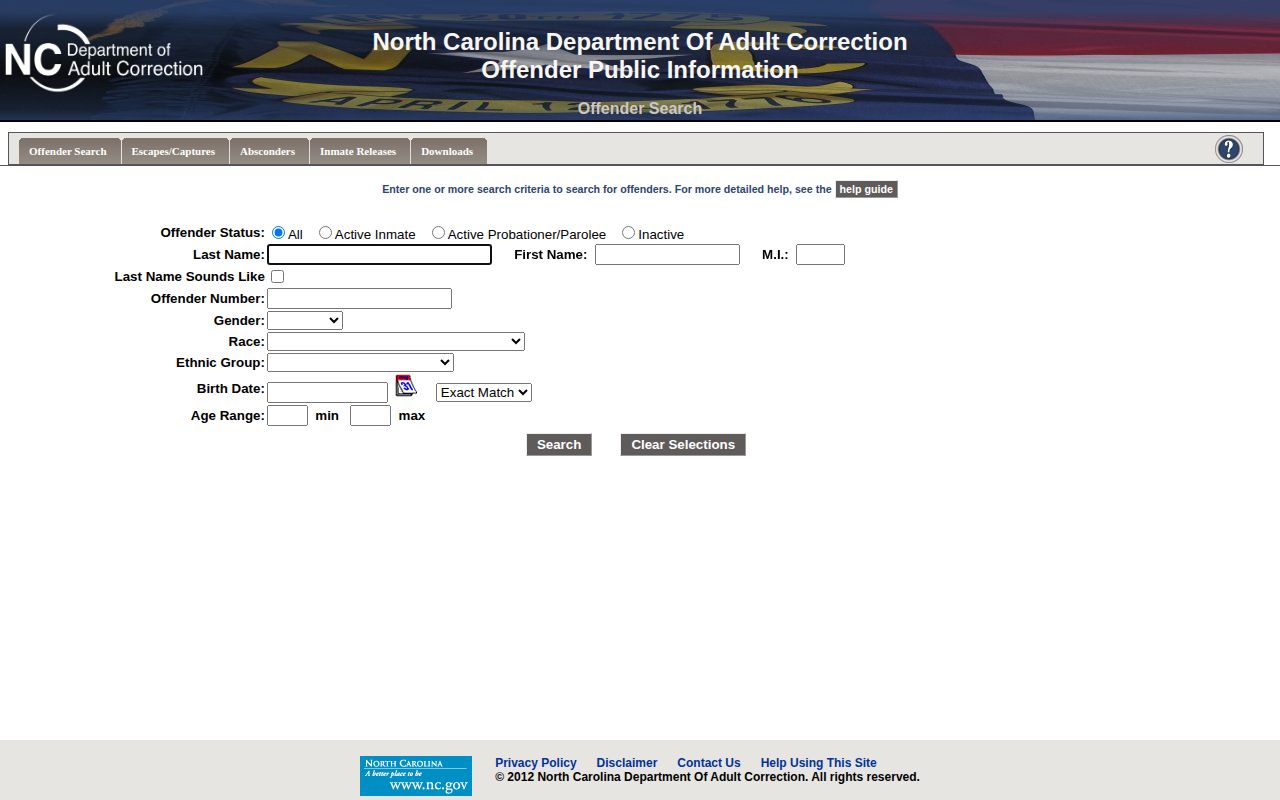
Use the live record to confirm the exact current labels. A screenshot is a navigation aid, not a substitute for a fresh record check.
Open every relevant event section. One person can have several sentences, convictions, or supervision events. A projected value for one sentence may not account for another consecutive judgment or a later correction unless the agency record has been updated. An Inactive label means the person is no longer active in the displayed NCDAC categories; it is not the projected date and does not reveal the precise release type by itself.
Edgecombe Structured Sentence Dates
North Carolina Structured Sentencing generally applies to crimes committed on or after October 1, 1994 and replaced ordinary parole for those offenses. Under G.S. 15A-1340.13(d), the minimum active term must be served. Earned time can reduce the maximum, but not below the minimum. G.S. 148-13 directs NCDAC to establish rules for awarding, forfeiting, and restoring earned time.
The written judgment ordinarily states a minimum and maximum rather than one flat date. G.S. 15A-1340.17 supplies the sentencing structures. Long Class B1 through E minimums and certain reportable offenses have special maximum-term formulas. Those statutes describe sentence construction, not a guaranteed calendar date for an individual.
- Minimum term
- The active term that must be served under the controlling judgment and law.
- Maximum term
- The longer term used with earned-time and post-release rules.
- Prior confinement
- Qualifying time already served that the judgment or law directs NCDAC to count.
- Concurrent
- Terms that run at the same time.
- Consecutive
- Terms that run one after another.
- Earned time
- An administrative allowance governed by NCDAC rules, with award, loss, and restoration conditions.
The offense date matters. Current rules should not be applied mechanically to an older parole-eligible case. Read the judgment and the law that governs that sentence.
Edgecombe 85 Percent Claim
NCDAC's parole-process material says North Carolina Structured Sentencing requires at least 100 percent of the minimum and 85 percent of the maximum. That statement is often reduced to “everyone serves 85 percent,” which is inaccurate. North Carolina judgments contain minimum and maximum terms, and the minimum has its own mandatory role. Offense class, prior record level, offense date, prior-confinement time, multiple judgments, earned time, discipline, and post-release rules can all affect the record.
A public estimate should come from the current NCDAC record for the correctly matched offender, read with the judgment. The statutory maximum calculation for some long terms can add a percentage and an additional period. Certain reportable offenses use another structure. Those rules make a one-line arithmetic shortcut even less reliable.
Why Edgecombe Projections Change
A projected date is an administrative forecast based on information available at that time. Earned-time awards, forfeitures, or restoration can affect the maximum side of a state term within legal limits. A corrected judgment can alter the terms or counted prior time. New sentences may run at the same time or in sequence. A disciplinary event, revocation, or return from supervision can change the person's active status. Intake and data-entry timing can also produce a short lag.
| Change source | Record to inspect | Possible effect |
|---|---|---|
| Prior-time correction | Filed judgment or court correction | Changes counted confinement |
| Earned-time action | NCDAC sentence computation | Moves the maximum-side calculation within law |
| Additional judgment | Court file and NCDAC sentence list | Adds concurrent or consecutive terms |
| Violation or revocation | Commission, court, and NCDAC events | Returns the person to custody or changes status |
| Transfer or delayed intake | Edgecombe release entry and NCDAC admission | Creates two agency dates for continuous custody |
Recheck the official record close to the anticipated event. A saved search result shows what the system reported on that date, not an unchangeable promise.
When two calculations differ, compare their inputs before choosing one. Confirm that both use the same offender number, judgment, offense date, sentence order, and NCDAC status. One estimate may omit a second active term or may treat concurrent sentences as consecutive. Another may mistake a supervision start for final discharge. Ask the record custodian to explain the displayed field rather than adopting an unofficial calculator.
Keep a dated copy of the judgment details and the current OPI result when tracking a change. Note which agency supplied each value and whether it described a minimum term, maximum term, projection, actual event, or supervision end. That short audit trail makes a later correction easier to understand. It also prevents a family from treating an old forecast as the latest official position.
Edgecombe Release and Supervision Dates
Release from prison and termination of a sentence can occur on different dates. G.S. 15A-1368.2 generally sets the move to post-release supervision by reference to the maximum term and specified supervision portion for covered sentence classes. Certain sentences use a longer period. Earned time can also operate within the statutory structure.
During that community phase, OPI may show Active Probationer/Parolee. The person is out of prison but not yet at final sentence termination. Completion of supervision ends the relevant sentence under subsection (f). A revocation can return the person to custody. Therefore three records may matter: the projected prison date, the actual prison release event, and the supervision termination event.
The Edgecombe parole and probation record path explains how to verify current supervision and office routing. It should be used after OPI shows community status, not as a way to estimate a county-jail bond departure.
Confirm Edgecombe Actual Release Dates
NCDAC maintains a separate Inmate Release Search. Verified result columns include offender number, name, release date, primary offense qualifier, and type of release. It can be searched by Edgecombe County and month, but that county filter concerns state correction records connected to the selected county. It is not a daily feed of people leaving the Edgecombe County Detention Center.
The successful NCDAC release-search capture shows the county-and-month form and state release-result columns:
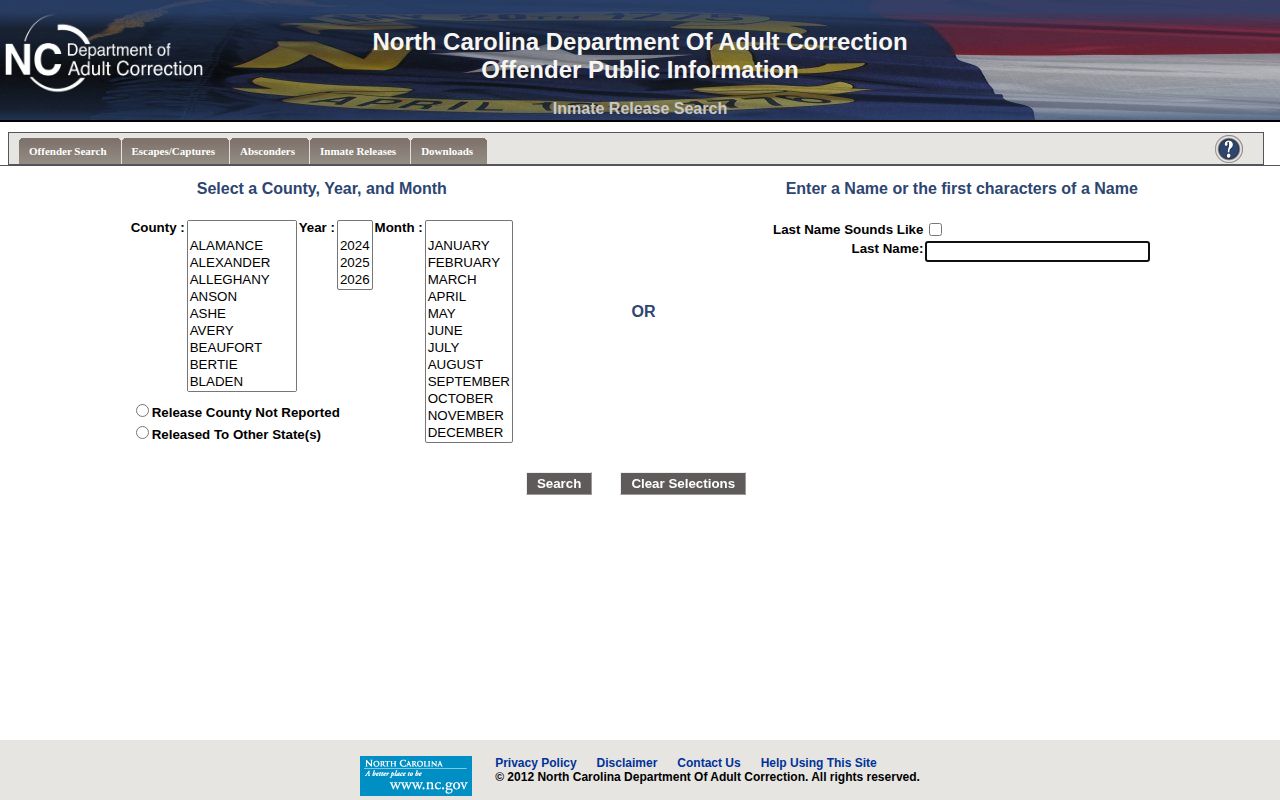
The release type and date in that report describe an actual NCDAC event after it posts. Preserve that wording instead of converting every result into “freed.”
For county detention, contact Edgecombe Detention at 252-641-7921 and ask whether the person is currently held, released to the community, or transferred. If released, request the effective date, time, and recorded type. If transferred, ask for the destination. Sheriff Records can provide the existing release or transfer entry subject to public-record limits. The Edgecombe Clerk directory routes requests for the filed judgment and later court orders.
- Match the booking number or NCDAC offender number.
- Label each timestamp by agency and event.
- Keep projected and actual dates separate.
- Check all active sentences and their sequence.
- Distinguish community release from transfer custody.
- Confirm whether supervision continues after prison.
Note: Court authorization can precede processing, and an agency transmission can follow physical movement by hours or days.