
Annex Release or Court Movement
The Edgecombe County Detention Center Annex is inside the county courthouse in Tarboro. That location creates a special verification problem. A person seen at the courthouse may be appearing before a judge, moving between a holding area and court, returning to the Annex, or being transported to the main jail. None of those movements alone proves that the person left Sheriff custody.
A community release may follow bond, a court order, time served, or completion of an eligible local sentence. A transfer can instead lead to the main center, another jail, state prison, a guarded medical setting, or another agency. Ask whether the Sheriff's record says actual release or only movement. Then ask for the time, disposition, and destination associated with that booking.
Confirm an Annex Release
There is no separate Annex roster or public release feed. Edgecombe County also publishes no countywide live inmate list, booking-card page, or rolling recent-release archive. The most direct path starts with Detention and Sheriff Records. A court check follows because the Clerk, not the Sheriff, keeps the filed judicial order.
- Identify the person and booking with full name, lawful birth details, case number, booking number, and an approximate date range.
- Ask Detention whether the person is at the Annex, at the main center, in court transit, released to the community, or transferred.
- Request the actual release or movement time, the recorded disposition, and the receiving agency if custody continued.
- Review the Edgecombe case for the bond order, dismissal, judgment, commitment, or other authority.
- Use VINELink as a status clue and notification path, then confirm the event with the Sheriff.
NCDAC should be used only if adult state correction is plausible. Its public search does not contain ordinary county-jail bookings. If the person was sentenced and transferred to state custody, allow time for intake before searching the state record. A failed state search does not convert an Annex departure into community release.
Annex Records and Contacts
The Sheriff's Records Division is the logical first custodian for the detention release or movement entry. The courthouse Clerk holds the court file. Contact the office that created the document being sought. The county has not published a special release-record request form, a records email, a fee schedule, or a response guarantee.
Edgecombe County Detention Center Annex301 St. Andrews Street
Tarboro, NC 27886
Detention: 252-641-7921
Edgecombe County Clerk of Superior Court
301 St. Andrews Street
Tarboro, NC 27886
252-824-3200
Monday-Friday, 8:30 a.m.-5 p.m.
For Sheriff records, use the Office of Sheriff at 3005 Anaconda Road, P.O. Box 219, Tarboro, NC 27886, or call 252-641-7911. Ask before visiting. Court hours are not jail release hours, and the county has not published Annex exit, pickup, property, weekend, or holiday procedures.
Request Annex Release Proof
A narrow request should name the person and approximate episode. Ask for existing documents rather than a custom report. Include the booking or case number if known. A request can seek the booking sheet, release log or screen entry, actual departure time, disposition code, transfer destination, and any movement record that distinguishes the Annex from the main center.
| Record source | Question answered |
|---|---|
| Sheriff booking record | Which custody episode and facility were involved? |
| Movement record | Was the person moved to court or another detention location? |
| Release entry | When did Sheriff custody end, and by what recorded type? |
| Transfer record | Which agency accepted custody next? |
| Clerk court file | What order or judgment authorized release or commitment? |
Ask for electronic copies and a fee estimate. North Carolina law does not require an office to create a compilation it does not possess. If a record or field is withheld, request the statute supporting the decision and any public portion that can be separated. A Portal screen can help locate the case, but the official filed document remains with the Clerk.
Edgecombe Annex Capacity Record
The current county detention page reports an official Annex capacity of 93. Some older planning material used 83, producing an older combined figure. The live county number should control current descriptions. Older figures may reflect a past date or classification method and should not be merged silently with the current count.
Capacity is not an occupancy figure and says nothing about a named person's status. The Annex and main center are two physical locations under one Sheriff operation. A requester may identify the Annex when known, but the same Detention and Records contacts remain the proper starting point.
Note: Annex capacity is a facility fact, not proof of a person's present custody or release.
The official main-and-Annex overview shows the facilities without a public release feed.
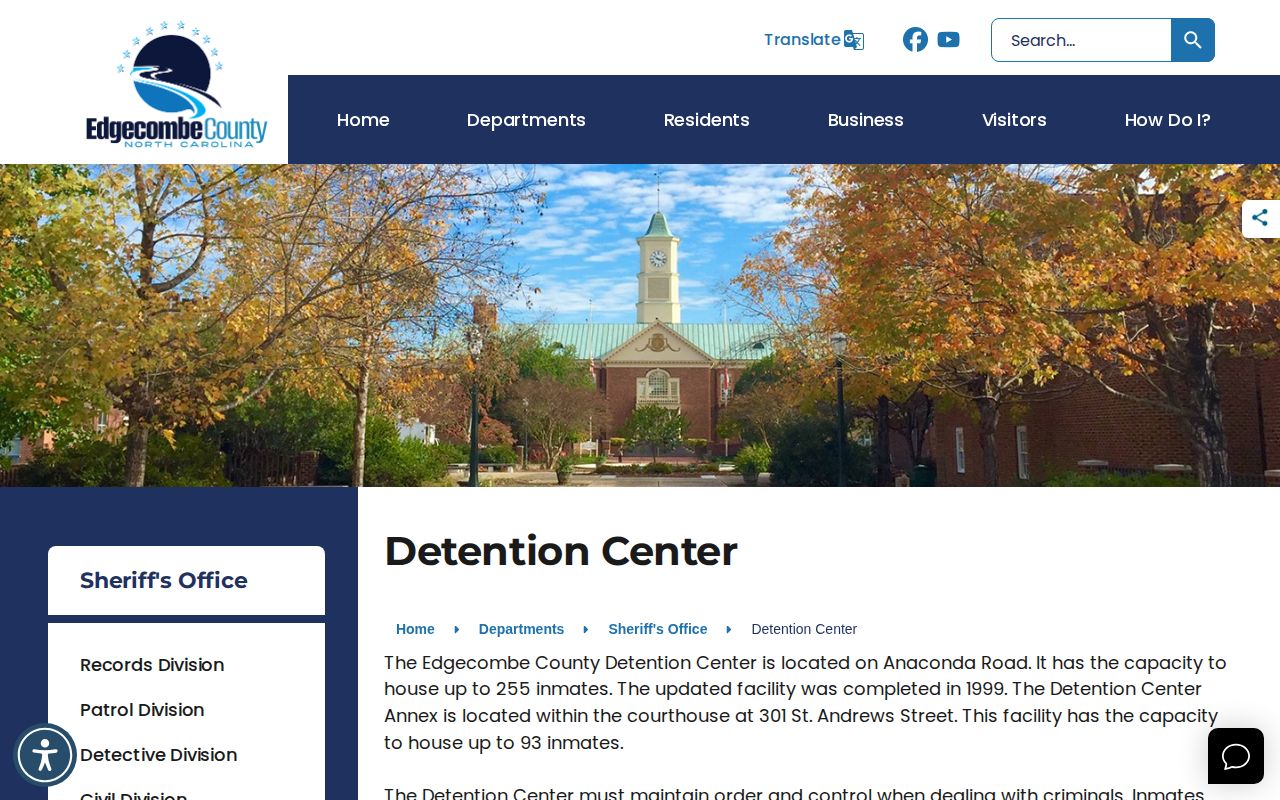
The page supports the direct Sheriff and Clerk workflow instead of an invented Annex release search.
Edgecombe Annex History and Role
Edgecombe's local adult detention arrangement combines a larger main facility completed or updated in 1999 with the smaller courthouse Annex. This is the facility-history angle that most affects a release search. The split allows short physical movements to occur near the court process, which can look like release to someone watching only one building.
The separately operated Youth Development Center in Rocky Mount is not part of this adult system. Its juvenile records use protected channels. Historical state prisons in Edgecombe County are also not current Annex destinations. Confirm the operator and population before choosing a database, since recycled directory entries can blur county detention, juvenile custody, and state prison history.
Read Annex Release Terms
The safest reading preserves the term used by the Sheriff. Bond ends confinement under stated conditions while a case can remain pending. Time served relates to the sentence terms identified by the judgment. A transfer ends the Annex stay but continues custody. Court-ordered release depends on the filed order and may still be subject to another hold.
- Internal movement
- A move among the Annex, main center, and court while Sheriff custody continues.
- Physical departure
- The time a person actually leaves the current custodian, which may follow an earlier court order.
- Receiving custodian
- The jail, prison, medical guard, or agency that accepts custody after transfer.
- Release disposition
- The agency's recorded reason the specific detention episode ended.
For a full named-person search and records workflow, use the Edgecombe County release search. Keep the booking, court, notification, and receiving-agency records distinct so each source answers only the question it is equipped to prove.
Preserve each response with its access date and booking identifiers. Edgecombe posts no online retention term for an Annex release archive because no such public archive exists. A prompt request is safer than assuming the entry will remain easy to retrieve. If a field seems wrong, send Sheriff Records the specific booking, disputed field, and supporting court document. Ask for the correction process and a written response.
Reconcile Annex Release Times
An Annex episode can produce a court authorization time, a Sheriff movement time, a release-processing time, a physical departure time, and perhaps a VINE transmission time. They are not interchangeable. A late court event can post on a different calendar day from the actual departure. Transport to the main center or a receiving agency can create yet another entry. Ask the custodian to define each field instead of choosing the time that seems most favorable.
If the court says a case is disposed, read the actual disposition and judgment. Dismissal, acquittal, plea, conviction, probation, and time served have different effects. A conviction can send the person to state prison, while a dismissal can coexist with another open case or detainer. The Clerk's filed order explains authority, and the Sheriff's release or transfer entry explains what staff did.
A VINELink notice is useful for a timely status change, but it is not a release certificate. Save the alert, agency name, and time, then ask whether the person entered the community or another custodian. If NCDAC intake is expected, search after transport and preserve the offender number. This sequence keeps a courtroom movement from being mistaken for the end of all custody.
Note: Courthouse movement, Sheriff departure, and receiving-agency intake may carry different official times for the same episode.
Public Record Search
Sponsored Results